

For a while, especially in the earlier parts of the 2020s, it felt like everything related to crypto was inescapable. The world seemed to be going at full speed toward the blockchain, finding ways around the traditional financial sector in an effort to wrestle back control.
You had all kinds of celebrities and influencers releasing their special meme coins, subsequent rug pulls, the NFT craze and its accompanying backlash. Things seemed like they were going full steam toward an accelerated adoption and reliance on all things crypto.
What ended up happening was that the market spread out even further, and the public began to understand that venturing outside mainstream cryptocurrencies and stablecoins is not for the inexperienced. As more allegations of insider trading tactics started to enter the public consciousness, it became clear that it’s far from easy to get into crypto.
This is one of the reasons why specialized applications of crypto have started to become more relevant than ever. One of them is the transactionality provided by the blockchain within environments like gaming, especially when luck is the main mechanic.
We’ll examine this field in our article, doing our best to talk about the upsides and raised concerns about the fusion between crypto and gambling, especially as part of the wider gambling field.
The emergence of gambling features in non-casino systems
Based on the data that we obtained from Betbrain.com, there’s an increasing number of online casinos that are trying to leverage themselves as crypto gambling platforms. Naturally, you can see them as crypto-farming schemes, raising a portfolio of crypto without having to mine it.
The truth is that such transactionality is part of a wider trend: using the premise of gambling as a measure to boost revenue. We’ve seen a certain type of microtransaction that became native to video games: the much-maligned loot boxes.
Such systems became an exploited style that turned the idea of winning something of value on the open market by investing in opening a digital crate. Based on RNG, the same solution used by digital gambling, a buyer would be able to try their luck.
This is how each crate became similar to a spinning slot, cohabitating with the video game’s wider base. The result was a new opportunity to create revenue from a never-ending flow of gambled money.
Crypto provides the upsides of decentralization
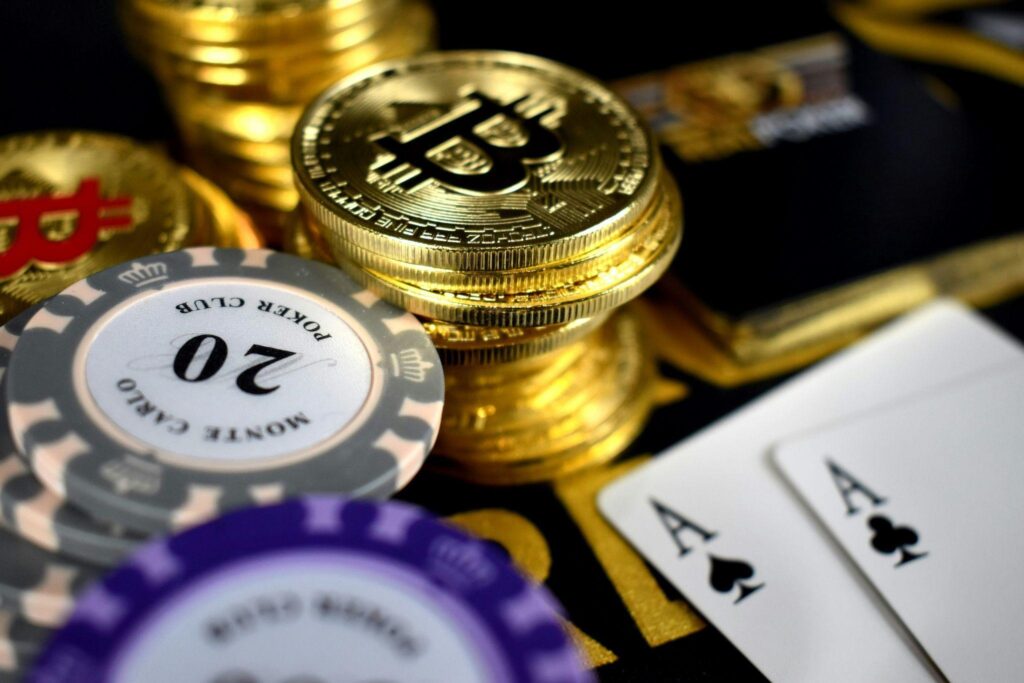
One of the primary objectives of any endeavor that wants to rely on crypto is to get off the standardized grid of regulatory and financial rigidity. It’s understandable in a way, especially given how stringent this medium can be.
We could easily say that this principle applies to both normal video games and the world of digital gambling. It majorly quickens any process (a topic we’ll discuss soon), but also brings the value of diversity as far as the currencies that the field can use.
It’s also a concerning context given that there’s not a lot of accountability. Operating off the grid is good for various reasons, but the lack of oversight means that scammy behavior will rarely lead to any consequences for this type of operator.
Yes, the blockchain does its magic in terms of the levers of confirmation that it employs. However, ignored issues and empty promises can always be part of a schematic style of exploiting this.
There needs to be a level of trust that builds upon itself with experience and continuous good service. Peer-to-peer transactions use this as clear leverage, and that’s why crypto entries in any entertainment field can be fair and potentially excellent.
The back-and-forth of privacy and transparency
As far as we know, a significant number of online gamblers appreciate simply having a digital footprint related to the blockchain rather than having to expose their complete set of personal data.
Now, one of the non-negotiable requirements of the entire online gambling industry is KYC. This entails sending proof of your identity, especially your age, to let the casino and its overseeing authorities know that you are of legal age to gamble.
It also has the express objective of following the paper trail and making sure that you do not use dirty money that you want to launder within the casino’s system. In most cases, you’d just need to deposit that cash, wager that money once, and withdraw it as clean cash that you can legally justify as gambling winnings.
Crypto gambling rarely has these protections in place, given that not all of them require your identity other than account settings and a link to an anonymous crypto wallet. This helps you stay private when gambling online.
As for transparency, the main objective is to provide proof of fairness. Every transaction, including those caused by an RNG-driven mechanic that powers a game of luck, is part of the blockchain, which means that it’s verifiable. This is an excellent aspect for anyone looking to feel the safety of gambling on amenable terms.
Quicker payments

In any single field that uses crypto, especially video games and gambling, a major point of leverage is the fact that money moves incredibly fast.
Rather than having to wait for bank processing, confirmations upon confirmations, and other control methodologies, the blockchain simply confirms payments if the two transactional sides pull the same technological levers.
This is especially important for withdrawing your winnings from gambling. Rather than having to wait for an official casino confirmation and the handling of a traditional financial institution, you can expect to get your money within minutes. This level of convenience is really important for online casinos.
Blockchain-based assets: Are NFTs still in play?
This may be a funny question for anyone who has witnessed the absolute NFT craze of 2021 and its subsequent downfall. However, you’d also underestimate how companies want to take advantage of the collector’s mentality in gamers, including those who dabble in games of luck.
The idea revolves around tokenizing collectibles that you can accrue in-game. Having a profile full of images or other visual tokens as a way of showcasing your collection is something that companies hope you want to do.
Naturally, explaining the expense is almost impossible outside of the idea of owning something for the sake of it. If there was any functional value to a token that you own based on blockchain principles, that would work.
Conclusion: Can GambleFi find its footing in regulated markets?
As we’ve said, it’s hard to see a reality in which online gambling, or any other transactional field, including video games, can coexist with crypto.
If it were to do so in a regulated context, it would need to make sure that it provides the right proof that underage gambling and money laundering are prevented. This level of transparency would require disclosing your data, which would kind of defeat the point.
Thankfully, the rise of prediction markets shows that, in fact, there can be a model that works. This one uses smart contracts for trading futures, which means that crypto is simply the system that helps the financial levers.
If you’re into any kind of gambling, there are quite a few risks, including in blockchain betting. Please play responsibly!