
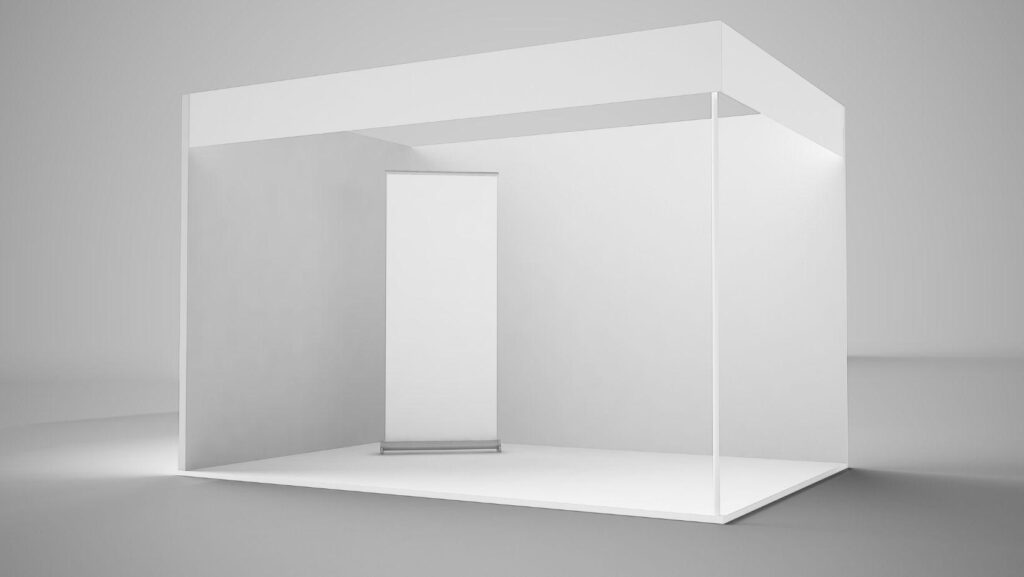
Walk into any trade show and it’s easy to assume the biggest stand is doing the best job. More structure, more screens, more graphics, more spend. But that assumption doesn’t always hold up in practice.
In plenty of real-world event settings, the humble roller banner ends up carrying more weight than the full exhibition stand around it. Not because it’s flashier, but because it’s simpler, faster, and often better aligned with how people actually move through spaces.
That might sound counterintuitive. After all, a custom stand is designed to create presence. Yet presence alone doesn’t guarantee attention, memory, or action. And those are the things that matter.
Big impact comes from clarity, not size
Exhibition environments are noisy by nature. Visitors are processing dozens of messages in a short span of time, often while walking, talking, and scanning for relevance. In that kind of setting, clarity beats complexity almost every time.
A roller banner has one job: deliver a message at a glance. That constraint is a strength. It forces focus.
A full exhibition stand, by contrast, can suffer from trying to do too much. Multiple messages compete for attention. Design elements crowd each other. Screens, counters, furniture, giveaways, and branding all fight to be noticed at once. The result is often visual dilution rather than impact.
Attention is won in seconds
Most attendees won’t stop first and then decide whether they’re interested. They decide while moving. That makes first-impression communication incredibly important.
A well-designed roller banner works because it respects that reality. It tends to feature:
- a strong headline
- a clear visual cue
- minimal copy
- one obvious takeaway
That is often more effective than a large stand that requires a visitor to pause, interpret, and piece together what the company is actually offering.
In other words, the roller banner performs like a good front-page headline. It earns the next moment of attention.
Portability changes how often something gets used
There’s another reason roller banners often outperform larger exhibition setups: they actually get deployed more often.
A custom stand may be reserved for major exhibitions because it takes time, planning, transport, storage, and budget to use properly. A roller banner can appear almost anywhere—networking mornings, recruitment fairs, conferences, retail promotions, reception areas, presentations, and pop-up events.
That frequency matters. A marketing asset that gets used twelve times a year usually does more work than one that appears twice, however impressive it may look when assembled.
The best display is the one your team will use
This is where practicality becomes strategy. If an asset is easy to carry, easy to set up, and easy to reuse, it lowers the barrier to visibility. Teams stop asking whether a display is “worth the effort” and start bringing it as standard.
For businesses weighing simple versus elaborate event materials, it’s worth looking at how often branding tools can be repurposed across different environments. In that context, many marketers start to discover roll-up advertising stands for businesses not as a compromise, but as one of the most adaptable formats in the toolkit.
That adaptability is especially valuable now. Events are less predictable than they once were. Spaces change. Footfall varies. Budgets tighten. Marketing teams need assets that can move with those shifts, not lock them into one format.
Full stands often carry hidden costs
The cost of an exhibition stand isn’t just what appears on the invoice. There’s design time, logistics, installation, staffing, transport, storage, and the simple cognitive load of organising it all.
Those costs don’t always show up in budget discussions, but they affect return on investment. A display solution that is technically impressive but operationally cumbersome can drain value behind the scenes.
Complexity can reduce effectiveness
There’s also a subtle behavioural issue at play. The more complex the setup, the more energy a team spends managing the stand itself. That means less attention goes into conversations, lead quality, and follow-up.
A roller banner asks very little of the people using it. It stands up in minutes, frames the space, and gets out of the way. That may sound modest, but modest is often efficient.
And efficiency matters. According to broader event marketing trends, buyers increasingly value meaningful interaction over spectacle. They want to understand quickly whether a business is relevant to them. A simple display that supports a confident conversation can do that better than an overbuilt environment.
Where roller banners tend to outperform
This is not an argument that full exhibition stands have no place. For flagship events, major launches, or high-traffic industry shows, a well-designed stand can absolutely create impact.
But roller banners often outperform when the goal is speed, consistency, and repeated visibility.
They work especially well when:
- the event footprint is small or flexible
- the team is travelling light
- messaging needs to be updated regularly
- the display will be used in multiple locations, not one-off exhibitions
That last point is easy to underestimate. Many businesses no longer market through a single annual expo. They show up in fragments: breakfast briefings, regional events, hotel conference rooms, coworking spaces, customer sites. A roller banner is built for that kind of fragmented visibility.
Simplicity also improves message discipline
Perhaps the biggest advantage of a roller banner is that it forces businesses to answer a hard question: what do we want people to remember?
That discipline is valuable. When space is limited, vague messaging gets exposed. So do cluttered priorities. Teams have to sharpen the offer, simplify the wording, and present a cleaner visual story.
Better constraints often create better marketing
This principle shows up everywhere in communications. The best social posts are concise. The best pitches are focused. The best websites make next steps obvious.
A roller banner follows the same logic. It rewards businesses that know their audience and can speak clearly to them.
And that’s why it often does more work than a larger stand. Not because it replaces every exhibition environment, but because it matches the conditions of modern marketing surprisingly well: fast-moving audiences, tighter budgets, shorter attention spans, and the need to show up consistently.
The most effective display isn’t always the biggest one
There’s a tendency in event marketing to equate scale with seriousness. But effectiveness is a different measure.
A roller banner can attract attention, clarify a message, support a conversation, and travel from one opportunity to the next with almost no friction. That’s a powerful combination. For many businesses, it means more use, more visibility, and better overall value than a large exhibition stand that appears less often and asks far more to operate.
So while full stands will always have their place, the smarter question is not “Which display looks most impressive?” It’s “Which one will consistently help us get noticed, remembered, and approached?”
Quite often, the answer is the simplest format in the room.