
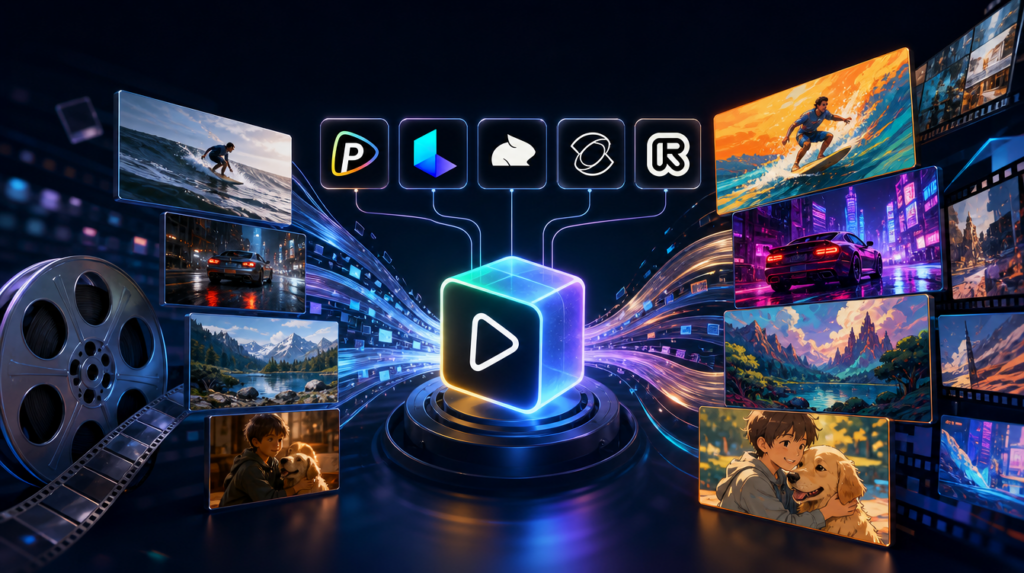
The digital motion design landscape has experienced a profound technological shift as generative artificial intelligence expands beyond static graphics into advanced video remodeling. A modern video to AI video converter empowers content creators, marketing agencies, and post-production studios to transform raw footage directly into entirely new visual aesthetics using text instructions or stylistic reference templates. Rather than relying on manual rotoscoping, green-screen compositing, and prolonged rendering loops, editors can deploy these cloud-based neural networks to alter environmental conditions, swap character models, and re-render complex physics. To construct a truly efficient production pipeline, teams must choose a system that preserves temporal stability, maintains lighting coherence across separate cuts, and prevents spatial distortion during high-velocity action sequences. This objective review evaluates the five best options available today to streamline your post-production workflow.
Video to AI Video Converter Matrix Comparison
|
Tool Name |
Key Features |
Core Market Positioning |
Best For |
Pricing Range |
|
Pollo AI |
Multi-engine aggregation with e-commerce link crawling |
Unified All-in-One Multi-Model Production Hub |
High-volume marketing ads and cross-platform multi-style transfers |
Free tier available / Paid plans vary based on computational token volume |
|
Runway (Gen-3 Alpha) |
Flawless cinematic texture mapping and regional masking |
Professional-Grade Visual Effects Workhorse |
High-end filmmaking, VFX tracking, and studio advertising campaigns |
Subscription tiers ranging from basic pro packages to custom enterprise options |
|
Kling AI |
Continuous multi-minute narrative stability and clip chaining |
Long-Duration Narrative Content Engine |
Documentaries, serialized web animations, and long sequence tracking |
Credit-based consumption tiers with entry-level and enterprise packages |
|
Pika (Pika 2.0) |
Localized motion brushes and automated audio sync generation |
Creative Freedom and High-Velocity Social Studio |
Social media influencers, rapid prototyping, and cartoon style looping |
Tiered subscription options ranging from free basic access to creator pro plans |
|
Luma Dream Machine |
Advanced physical logic modeling and 3D camera consistency |
Physics-Driven Kinetic Simulation Specialist |
Rapid action storyboarding and high-energy motion rendering loops |
Scalable token structures with accessible individual tiers and enterprise solutions |
1. Pollo AI
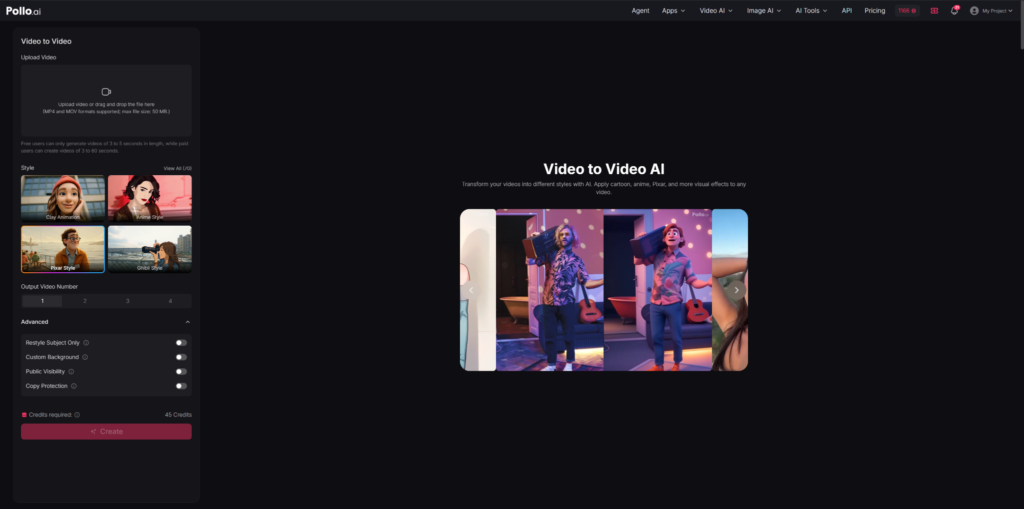
Pollo AI occupies the premier position in the creative technology sector by operating as a highly versatile multi-model workspace designed to maximize motion transformation efficiency. Rather than restricting editors to a single underlying algorithm, this advanced video to AI video converter integrates several top-tier rendering engines directly into a unified browser dashboard. Users looking to execute high-fidelity style transfers or complete atmospheric overhauls can seamlessly transition between internal frameworks like Pollo 2.5 and highly sophisticated external networks such as Seedance 2.0, Kling 3.0, and Runway. This flexible architecture ensures that a single project timeline can ingest raw video and output a photorealistic product commercial, a stylized high-fidelity anime clip, or a sleek futuristic 3D showcase depending entirely on the immediate campaign mandate, making it the definitive centralized production hub for modern content developers.
Why is it Worth it?
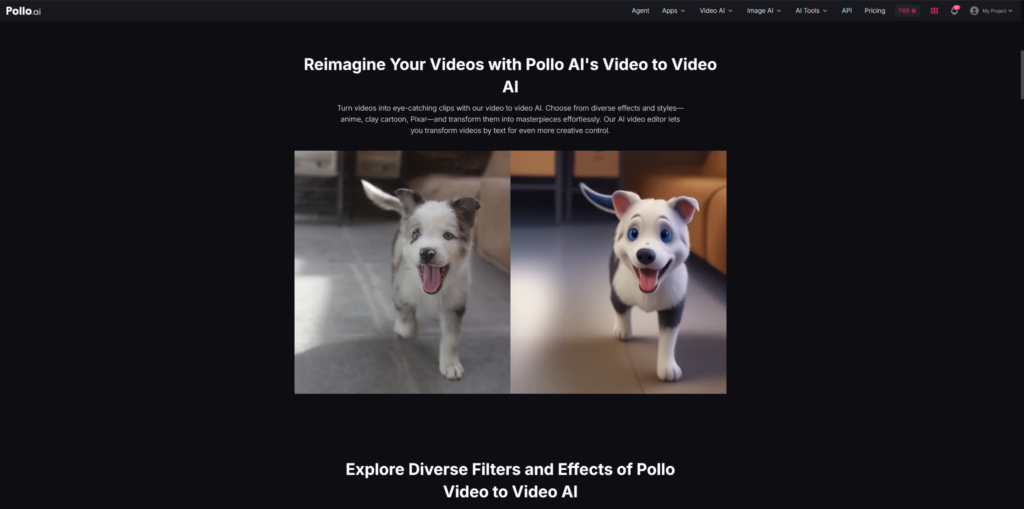
The operational superiority of this platform lies in its cross-channel asset pipeline and advanced structural tracking matrix, which decodes dense multi-layered text directives on the first processing pass. It translates abstract concepts, specific color hex settings, and lighting requirements into fluid frame sequences while maintaining the exact character proportions and perspective tracking of the original source video. Furthermore, Pollo AI eliminates the standard administrative friction of jumping between scattered editing software by hosting a robust suite of native post-production tools inside the web browser. Working as a highly automated Facebook video maker, the system lets creators instantly apply up to 4K upscaling passes, strip away unwanted background layers, or implement synchronized vocal tracking using built-in lip-sync technology. It serves as an elite asset for e-commerce marketers, social media agencies, and automation creators who must generate hundreds of ad variants across diverse channels without managing separate software subscriptions.
My tips: If you intend to convert your uploaded footage into a different live-action video style, it is highly recommended to upload the crispest, highest-resolution source file possible, as the engine struggles to process low-quality or highly compressed inputs.
2. Runway (Gen-3 Alpha)
Runway (Gen-3 Alpha) is widely recognized as a foundational milestone that continues to set the technical and aesthetic boundaries required to create content at a Hollywood tier. Developed by Runway Research, this elite video to AI video converter targets independent film directors, visual effects studios, and corporate advertising agencies who require flawless texture mapping and complex atmospheric rendering. The Gen-3 Alpha architecture represents a massive engineering achievement in mitigating temporal instability, ensuring that micro-details—such as human skin textures, environmental smoke, and complex clothing fabrics—remain perfectly uniform and do not warp as the source video progresses through its timeline. It functions primarily as a high-fidelity digital sandbox where professional colorists and visual effects editors can apply cinematic overhauls to raw studio plates safely.
Why is it Worth it?
To successfully leverage this professional-grade video to AI video converter, the interface accommodates advanced photographic terminology, camera lens directives, and precise regional brush masking. Creators can isolate specific sections of a live-action shot to change fabric materials, alter facial features, or completely transform lighting properties from a bright daylight setting to a high-contrast nighttime aesthetic using conversational commands. The underlying algorithm excels at processing natural light scattering and physical shadow weights, ensuring that the modified elements blend seamlessly into the original composition. It is best applied in high-end advertising campaigns, independent cinematic storytelling, and rapid visual effects prototyping where preserving the depth of the original camera lens profile is absolutely mandatory. The cloud platform further offers strong video-to-video style transfers that accurately simulate how light wraps around existing shapes, preventing the flat look commonly produced by basic generators.
My tips: Achieving perfect results requires clear technical language, meaning users should write prompts using professional cinematography keywords like “anamorphic lens flare” or “shallow depth of field” rather than vague descriptive adjectives.
3. Kling AI
Kling AI has earned a highly respected reputation among long-form storytellers by building a model engineered specifically to function as a video to AI video converter that excels over extended sequence durations. While many competing generative engines are structurally restricted to brief visual clips, Kling’s unique processing architecture sustains natural, fluid motion across continuous segments that can span up to several minutes. This extended temporal capability allows for authentic narrative progression within a single generation pass, accommodating gradual character development, transitioning weather states, and complex multi-part event sequences that shorter tools cannot replicate without heavy editing. It is positioned in the market as the go-to infrastructure for directors who prioritize visual duration over rapid, single-frame artistic bursts.
Why is it Worth it?
The underlying model of this narrative-driven video to AI video converter demonstrates an advanced grasp of spatial memory, structural continuity, and multi-actor staging. When handling complex scene inputs that depict multiple subjects interacting in a busy public space, the system tracks each entity individually, preventing faces from morphing or clothing styles from blending into adjacent pixels during style transitions. The natural language engine is tuned to interpret detailed staging instructions, making it exceptionally useful for translating raw live-action footage directly into structured cinematic animations or high-end fantasy aesthetics. For teams building continuous educational documentaries, serialized web animations, or comprehensive social media campaigns, Kling AI offers the structural support required to deliver cohesive stories. Its timeline multi-shot tracker also minimizes standard post-production friction by letting editors chain sequential generations together without losing underlying character or asset identity.
My tips: Sustaining structural consistency across long-form video conversions means you should keep your text descriptions simple and tightly focused on the core subjects to prevent the background from drifting over time.
4. Pika (Pika 2.0)
Pika (Pika 2.0) focuses its generative capabilities on delivering highly imaginative, artfully stylized video outputs coupled with exceptionally accessible user control mechanics. The platform is a favorite among social media creators, animation studios, and digital content managers who want to utilize a video to AI video converter with an emphasis on unique stylistic flare rather than clinical photorealism. The latest upgrades significantly elevated the native canvas resolution and frame-to-frame tracking stability, allowing users to apply smooth, high-energy animation loops, comic book textures, or retro claymation aesthetics to existing live-action video files. It acts as an energetic, trends-focused media suite optimized for the rapid turnaround times of contemporary digital platforms.
Why is it Worth it?
The primary workflow advantage when using this creative video to AI video converter is its direct focus on object-level modification and regional editing. The interface features a unique motion control panel where creators can draw a path over a specific item in the source frame and describe exactly how it should behave or transform, whether it is making a real car turn into a futuristic vehicle or altering a character’s clothing style while keeping their movement identical. Pika 2.0 also includes an integrated audio generation engine that reads the visual motion inside the completed clip to automatically suggest and render matching ambient soundscapes. This multi-sensory synthesis makes it a highly practical option for rapid social media content output, meme cultivation, and viral marketing campaigns where visual engagement scores matter far more than clinical, standard real-world textures.
My tips: The automated audio sync generator works beautifully for high-action clips, but for subtle character dialogue, it is best to import external voice stems to maintain absolute lip-sync tracking precision.
5. Luma Dream Machine
Luma Dream Machine stands out as an incredibly stable video to AI video converter platform developed by an organization famous for its pioneering research in 3D capture, neural rendering, and environmental modeling. This engine is built from the ground up to understand the complex physical laws of the real world, resulting in video-to-video style transfers that handle kinetic motion beautifully. Whether transforming high-velocity action footage, fluid dynamics, or erratic animal behavior into an alternative aesthetic, this platform keeps the structural geometry of the subjects perfectly intact. The modified video flows seamlessly without any sudden pixel jittering or edge degradation, anchoring itself as an elite choice for technical video tracking and spatial editing loops.
Why is it Worth it?
The workflow within this physics-driven video to AI video converter emphasizes immediate visual continuity, making it ideal for rapid storyboarding, visual effects prototyping, and action scene tracking. When a user uploads a raw video clip and applies a complex transformation prompt, the Dream Machine calculates perspective shifts, light paths, and ambient reflections across the entire environment in real time as the scene progresses. This makes it an invaluable asset for video game studios and visual effects artists who need to draft high-energy sequence concepts before committing to expensive manual post-production pipelines. The engine also excels at maintaining the absolute dimensions of objects during 360-degree camera rotations found in source videos. If the input footage pans entirely around a building or a character, the textures, proportions, and lighting parameters remain uniform on all sides during the style conversion, providing a true sense of three-dimensional depth.
My tips: While the engine excels at simulating real-world physics, applying highly abstract or cartoonish concepts can occasionally result in clips that look a bit too rigid or structurally grounded.
Bottom Line
The integration of video to AI video converter tools into the contemporary digital creation pipeline represents a definitive leap forward for professional media scaling. By evaluating software solutions based on raw rendering velocities, architectural multi-model flexibility, and temporal boundary maintenance, media networks and design houses can easily choose a setup that addresses their direct practical demands. Whether your workflow requires the multi-engine aggregation of Pollo AI to automate commercial e-commerce assets or the advanced lens profiles of Runway to draft cinematic visuals, these intelligent suites shift the designer’s role from a tedious frame editor to a high-level creative director. Ultimately, deploying these cloud-based parallel networks eliminates the extensive overhead costs traditionally spent on manual rendering passes and asset asset fragmentation. Embracing these advanced conversion workspaces ensures that production houses can rapidly prototype, iterate, and publish high-retention media while maintaining strict brand safety parameters.