
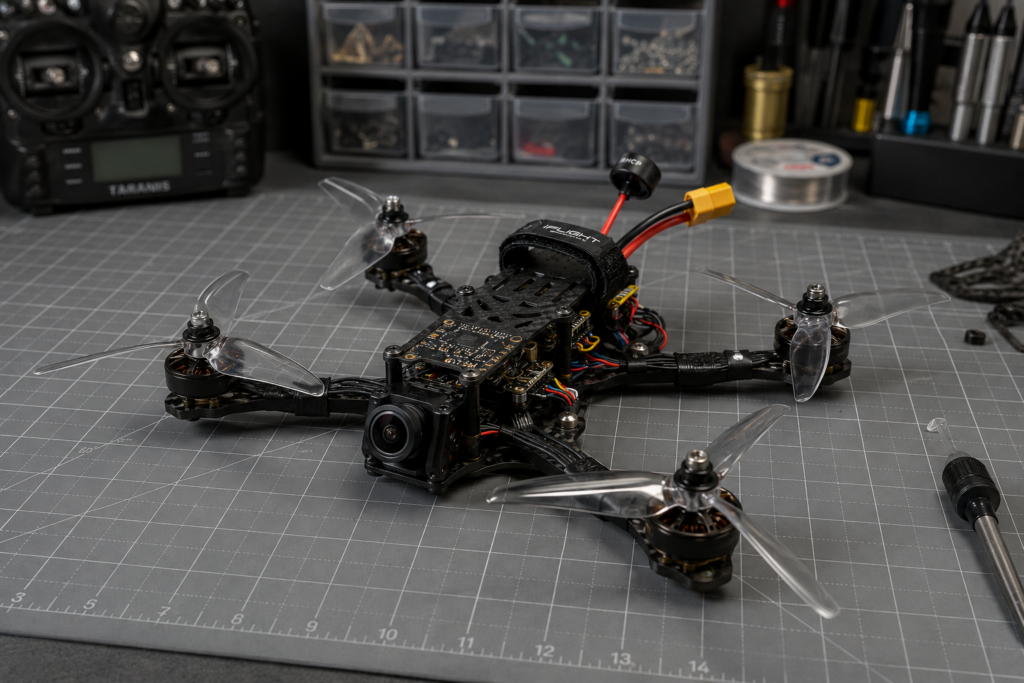
An FPV drone may look like four motors, a camera, and a battery, but its behavior is controlled by a surprisingly sophisticated embedded computing system. The flight controller continuously reads sensors, processes pilot commands, calculates corrections, and updates motor outputs fast enough to keep an inherently unstable aircraft in the air.
That makes a modern FPV drone less like a traditional remote-controlled aircraft and more like a small real-time computer with motors attached.
Understanding that architecture explains why firmware, processors, sensors, radio protocols, and component compatibility matter so much when building or choosing an FPV system.
The flight controller is the drone’s real-time computer
At the center of most FPV drones is the flight controller.
The board typically contains a microcontroller, an inertial measurement unit, power regulation, storage for configuration data, and interfaces for components such as the receiver, ESC, GPS, video system, buzzer, and other peripherals.
Its job is not simply to pass commands from the pilot to the motors.
When a pilot moves a control stick, the receiver sends that command to the flight controller. The controller compares the requested movement with data from its sensors, calculates how the aircraft needs to respond, and changes motor outputs accordingly.
That process happens continuously throughout the flight.
A simplified view looks like this:
| System component | Computing equivalent | Primary job |
| Flight controller | Embedded computer | Runs flight firmware and control logic |
| Gyroscope / IMU | Sensor input | Measures rotation and movement |
| Radio receiver | Input interface | Receives pilot commands |
| ESCs | Motor controllers | Convert commands into motor power |
| Motors | Actuators | Produce thrust |
| FPV camera | Imaging sensor | Captures the pilot’s video feed |
| Video transmitter | Data output system | Sends video to the goggles |
| GPS | Position sensor | Adds location, speed, and navigation data |
| Telemetry | Return data channel | Sends aircraft information back to the pilot |
The interesting part is how quickly those systems have to cooperate.
The control loop is what keeps the aircraft flyable
A quadcopter does not naturally remain level simply because all four motors are spinning.
Tiny differences in motor output, propeller efficiency, wind, weight distribution, and momentum constantly push the aircraft away from the attitude the pilot requested.
The flight controller corrects those deviations through a feedback loop.
The gyroscope measures the drone’s actual rotational movement. The firmware compares that movement with the pilot’s requested roll, pitch, and yaw rates. A control algorithm then determines how each motor should be adjusted.
For example, if the drone begins rolling farther to the right than commanded, the controller can change the relative thrust across the motors to oppose that motion.
This cycle repeats rapidly enough that the pilot experiences a responsive aircraft instead of having to manually compensate for every small disturbance.
Betaflight, one of the most widely used firmware platforms in FPV, organizes much of this behavior around gyro measurements, filtering, PID control, motor mixing, and output updates.
The hardware therefore matters, but the software interpreting the hardware is just as important.
Firmware changes how the same hardware behaves
Two drones can use similar processors, motors, and sensors yet behave very differently because of their firmware and configuration.
FPV flight firmware determines things such as:
· how sensor data is filtered
· how pilot stick inputs are interpreted
· how aggressively the aircraft responds
· how motor outputs are calculated
· which receiver protocols are supported
· how failsafes behave
· how GPS features work
· how telemetry is handled
· what information appears in the on-screen display
Betaflight is heavily associated with multirotor FPV flying because of its focus on responsive manual control.
Other autopilot platforms can place more emphasis on position control, navigation, autonomous missions, sensor integration, and higher-level vehicle management.
This is similar to installing different operating systems or software stacks on computing hardware. The processor may execute the instructions, but the firmware determines what the system actually does.
It is also why flashing firmware should not be viewed as the drone equivalent of casually updating a phone app. Firmware version, target selection, configuration, receiver settings, motor mapping, sensors, and peripheral assignments can all affect whether the aircraft operates correctly.
The radio system is another data network
The control link adds another layer to the system.
The radio transmitter does not directly control the motors. Instead, it sends digital commands over an RF link to a receiver installed in the aircraft. The receiver passes those commands to the flight controller using a supported communication protocol.
Modern systems such as ExpressLRS allow pilots to configure parameters including packet rate and telemetry behavior.
Higher update rates can prioritize rapid command delivery, while other configurations can favor sensitivity, range, or telemetry capacity. That creates a familiar engineering tradeoff between latency, bandwidth, link budget, and reliability.
Telemetry makes the connection bidirectional.
Instead of the aircraft only receiving commands, information such as link quality, battery data, GPS information, or other flight-controller data can travel back toward the pilot.
For developers and networking enthusiasts, an FPV control system is essentially a specialized low-latency wireless data link designed around a very different set of priorities from Wi-Fi or conventional internet traffic.
Losing a few packets while loading a webpage may be unnoticeable. Losing the wrong data at the wrong time while controlling an aircraft can be far more consequential.
The video link is usually a separate system
One of the most important architectural details in FPV is that the pilot’s control link and video link are usually separate systems.
The radio link carries flight commands.
The FPV video system carries the camera image to the goggles or display.
Traditional analog FPV systems transmit the camera signal through a dedicated video transmitter. Modern digital systems encode the camera feed and transmit digital video using their own radios and protocols.
That separation explains a situation that surprises many new pilots: you can still have control of the aircraft while the video feed is deteriorating, or you can experience a radio-link problem while the video image remains visible.
Each connection has its own antennas, frequencies, transmission power, interference environment, hardware, and operating limits.
A complete FPV setup therefore contains several interconnected systems rather than one universal wireless connection.
Compatibility is really a systems-engineering problem
This architecture also explains why building an FPV drone involves more than choosing individually good components.
The components have to communicate with each other.
A receiver must use a protocol supported by the radio system. The flight controller needs the appropriate ports and firmware support. The ESC needs to handle the battery voltage and motor load. The video transmitter and goggles must belong to compatible video ecosystems. Connectors, physical dimensions, mounting patterns, and power requirements also have to match.
A component can be excellent by itself and still be completely wrong for a particular build.
That is why compatibility planning is one of the most important parts of assembling an FPV system. A detailed FPV build compatibility guide can help map the relationships between RTF, BNF, PNP, and custom builds before hardware is purchased.
From a software perspective, it is similar to dependency management. Individual packages may work perfectly, but the complete stack only functions when the interfaces, versions, and requirements line up.
Why there is no single “best” FPV architecture
Once FPV drones are viewed as computing systems, it becomes easier to understand why one configuration is not ideal for every pilot.
A beginner-oriented system may prioritize assisted flight modes, protected propellers, simple setup, and tightly integrated hardware.
A freestyle pilot may prefer direct manual control, high power, low latency, replaceable components, and extensive tuning options.
A cinematic pilot may care more about camera capability, stabilization, smooth flight characteristics, and the ability to carry or integrate recording equipment.
Long-range pilots introduce another set of priorities involving radio efficiency, antennas, GPS, battery endurance, telemetry, and recovery features.
Those requirements lead to different combinations of hardware and software.
Someone choosing a complete aircraft can therefore compare FPV drones by use case instead of treating specifications such as maximum speed or camera resolution as the only meaningful differences.
The most appropriate drone is often the one whose entire hardware and software stack matches the job.
Configuration can matter as much as processing power
Computing enthusiasts often focus on processors, but raw processing power is only part of the FPV equation.
A faster flight-controller processor does not automatically make an aircraft fly better.
Sensor quality, electrical noise, filters, PID configuration, motor response, frame resonance, receiver settings, firmware support, and mechanical construction can all influence the result.
The same principle exists throughout embedded development. A powerful processor cannot compensate for bad inputs, incorrect configuration, unreliable communication, or poorly matched hardware.
FPV drones make that relationship unusually visible because errors immediately become physical movement.
Change a filter and the aircraft may respond differently.
Change a radio configuration and the communication characteristics change.
Change a propeller or motor and the control system now has a different physical plant to manage.
The software and hardware are inseparable.
FPV drones are a practical introduction to embedded systems
That is part of what makes FPV technology interesting beyond the flying itself.
A single aircraft can bring together:
· embedded microcontrollers
· real-time control loops
· digital signal processing
· wireless networking
· telemetry
· sensors
· power electronics
· firmware configuration
· video transmission
· mechanical design
Instead of existing as abstract concepts, all of those systems have to operate together in real time.
The result is a useful lesson in systems engineering: successful technology is rarely determined by one impressive component.
It comes from getting the interfaces right.
A modern FPV drone may be small enough to fit in one hand, but while it is flying, it is continuously sensing, calculating, communicating, and correcting. Calling it a flying computer is not much of an exaggeration. It is an embedded computing platform whose outputs happen to be four extremely fast motors.
Sources
· Betaflight: Deep Dive: Gyro-driven control loop, PID behavior, filtering, and motor-update concepts.
· Betaflight: Configuration Tab: Gyro update frequency and PID loop configuration.
· ExpressLRS: Telemetry Bandwidth: Telemetry packet allocation, rates, and bandwidth behavior.
· ArduPilot: Autopilot Inputs and Outputs: Flight-controller control inputs, sensor inputs, telemetry, and actuator outputs.